Baking Utensils Clipart Sweet Creations
A Floral Touch for Every Kitchen Project
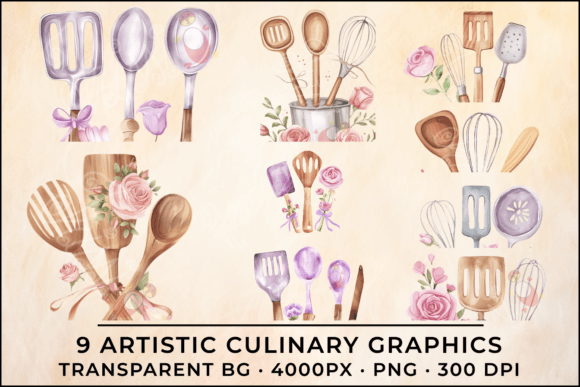
There's a certain warmth that comes with hand-drawn, watercolor art. It feels personal, crafted with care, and full of charm. The Baking Utensils Clipart Sweet Creations collection captures this feeling perfectly. It’s not just a set of generic kitchen icons; it’s a curated suite of illustrations where classic baking tools—whisks, rolling pins, spatulas, and mixers—are delicately adorned with soft pink roses and lush botanical leaves. Each piece is rendered in a gentle watercolor style, giving it a soft, organic texture that feels both timeless and inviting. The personality here is unmistakably sweet, feminine, and artisanal, appealing directly to an audience that values handmade aesthetics and detailed, quality design.
What makes this clipart bundle particularly useful is its practical, professional construction. You receive nine high-resolution PNG files, each a substantial 4000 by 4000 pixels at 300 DPI. This isn’t low-resolution web art; it’s print-ready quality that can scale to large formats without losing clarity. The transparent backgrounds are the real workhorse feature, allowing these illustrations to layer seamlessly over photographs, colored backgrounds, or within complex layouts in any design software. For a designer or content creator, this eliminates hours of tedious clipping path work and opens up immediate creative possibilities.
Practical Applications: From Digital Screens to Printed Goods
The true value of a design asset like this is measured in its versatility. Where does Baking Utensils Clipart Sweet Creations find its home? The applications span a wide creative spectrum. For branding and marketing, these illustrations are gold. A small bakery or a cottage food business can use them to craft a cohesive brand identity—think logos, business cards, and menu designs that immediately communicate a homemade, premium quality. The consistent floral and utensil motifs help build instant brand recognition. When used in social media graphics, they stop the scroll, offering a visual break from stock photography that feels more authentic and aligned with a food-centric or lifestyle brand's voice.
For publishing and content creation, the utility is equally strong. Bloggers can integrate these watercolor bakery elements into their site headers, blog post graphics, and featured images to enhance visual storytelling. They are perfect for creating beautiful recipe cards and recipe illustrations that readers will want to save and print. In editorial design for magazines or cookbooks, they can serve as elegant chapter openers, marginalia, or decorative frames for text, adding a layer of sophisticated visual hierarchy without overwhelming the page. The botanical baking theme makes them especially suitable for spring or wedding-themed content.
Beyond the screen, think tangible products. The high resolution makes them ideal for packaging design on boxes, labels, and stickers for baked goods. They translate beautifully onto merchandise like tote bags, aprons, and t-shirts for a baker gift line. For home crafters, they are perfect for creating personalized kitchen decor—framed prints, oven mitts, or tea towels. The possibilities for commercial and personal use are extensive, limited only by the creator's imagination.
Integrating the Art: Design Considerations and Best Practices
Using clipart effectively goes beyond simply dropping an image onto a canvas. To maintain a professional and cohesive look, consider these practical guidelines. First, think about font pairing. The organic, handwritten nature of this art pairs best with typefaces that complement rather than compete. A clean, modern sans serif font for body text can provide excellent contrast and readability, while a elegant script font or a soft handwritten font can be used sparingly for headlines to echo the art's personal touch. Avoid overly ornate or rigid serif fonts that might clash with the watercolor fluidity.
Color harmony is another key factor. While the clipart has its own palette, you can easily sample colors from the illustrations to create a unified color scheme for your entire project. This ensures the art feels integrated, not just pasted on. When composing layouts, use the illustrations to guide the viewer's eye. A whisk pointing toward a headline or a floral arrangement framing a call-to-action can create subtle but effective visual flow. Always consider the context of your design assets. For a formal wedding invitation, you might use a single, elegant sprig. For a vibrant bakery Instagram story, a playful arrangement of multiple utensils could work perfectly.
Finally, always verify the licensing. Most professional clipart bundles like this are licensed for both personal and commercial use, but it's crucial to read the terms. Understanding the license ensures you can confidently use the art in client work, products for sale, or across your digital platforms without concern. By treating these illustrations as a foundational part of your design toolkit—rather than just decoration—you can elevate your projects, strengthen your brand's visual language, and connect with your audience through a universally appealing aesthetic of sweetness and care.